
CE Expiration Date: April 5, 2029
CEU (Continuing Education Unit):1 Credit(s)
AGD Code: 070
Educational aims and objectives
This self-instructional course for dentists looks at the importance of using the dental microscope in endodontics and ergonomic ways to enhance comfort and performance.
Expected outcomes
Endodontic Practice US subscribers can answer the CE questions by taking the quiz online to earn 2 hours of CE from reading this article. Correctly answering the questions will demonstrate the reader can:
- Identify the physical issues that endodontists face when ergonomic principles are not followed.
- Identify the advantages of using the dental microscope for the dentist and the team.
- Recognize the importance of using a proper Microscope Depth of Field Setting.
- Realize the role of mirror-handling skills.
- Receive some patient positioning tips.
- Realize the crucial role that an assistant plays in enhancing ergonomics.
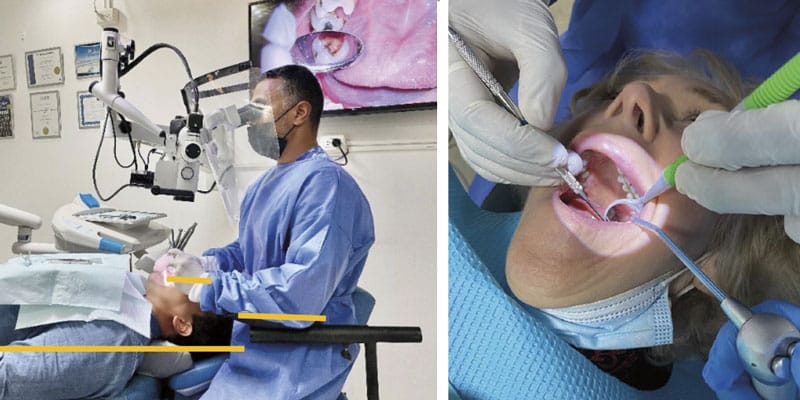
Dr. Juan Carlos Ortiz Hugues discusses the endodontic microscope and its ergonomic and clinical benefits in the modern endodontic practice.
Abstract
The dental microscope has been a key technology that has improved outcomes in root canal procedures since its incorporation in the 1990s. However, despite its mandatory status in endodontic postgraduate programs at dental schools, it is still underused or improperly utilized. This is primarily because operators often find themselves adapting to the technology rather than the technology adapting to them.
By applying ergonomic principles to endodontic practice and gaining a better understanding of the microscope, dental professionals can integrate this tool more effectively into their practices. This integration can enhance workflow during endodontic treatments, resulting in fewer interruptions and greater ease of use. Ultimately, this not only improves the outcomes of root canal treatments but also enhances operator comfort and performance in the long term, safeguarding both their physical and mental well-being.
Introduction
Ergonomics and human factors are critical yet often neglected areas in dentistry, focusing on optimizing the fit between the job and the worker, both physically and cognitively. These disciplines have been pivotal in enhancing various industries, including manufacturing and aviation, which face significant physical and cognitive challenges.1
The demanding nature of dentistry is marked by factors such as awkward postures, physical forces, prolonged tasks, and cognitive demands like decision-making and motivation.2 With studies showing over 80% of dentists suffering from musculoskeletal disorders and a 13% burnout rate, it is essential for educational institutions to emphasize ergonomic training to address these issues.3,4
Consistently applying ergonomic principles can significantly improve several key areas in dental practice:5
-
- Posture and positioning: Maintaining spinal alignment to reduce strain.
- Four-handed dentistry: Enhancing collaboration with assistants for efficiency.
- Office organization: Structuring the workspace for optimal workflow.
- Productivity: Streamlining tasks through better organization.
- Cognitive functions: Improving focus and decision-making capabilities.
- Equipment selection and use: Choosing tools that promote ergonomic safety.
The dental microscope, introduced by Gary Carr in the 1990s, has transformed endodontics, becoming essential in postgraduate training.6,7 Its benefits extend beyond magnification and lighting, significantly impacting ergonomics when used correctly. However, simply owning a microscope does not ensure its effective use; proper training is vital. 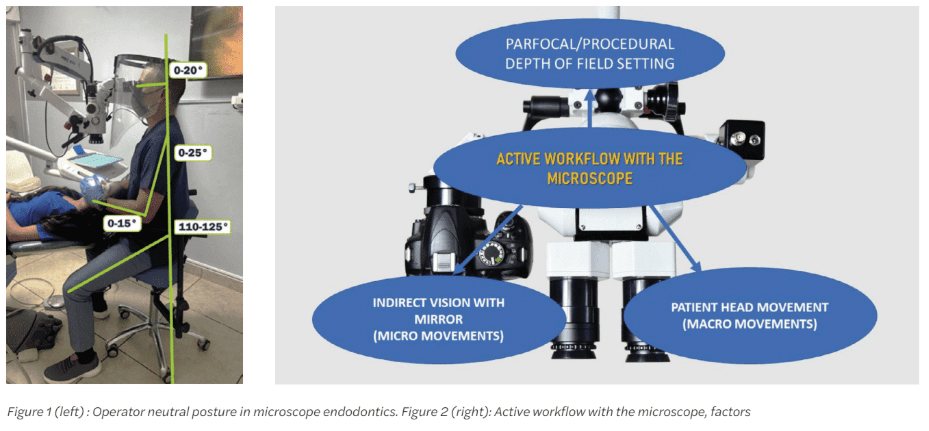
Effective use of the dental microscope can enhance:8
-
- Neutral posture: Reducing physical strain during procedures (Figure 1).
- Focus and concentration: Minimizing errors and improving precision.
- Controlled movements: Conserving energy and reducing fatigue.
- Improved visibility: Leading to better performance outcomes.
- Team collaboration: Allowing each team member to focus on their specific roles.
- Overall performance and efficiency: Enhancing job satisfaction and patient care quality.
By prioritizing ergonomic practices and proper training in advanced tools like the dental microscope, dental professionals can mitigate the challenges of their demanding field, promoting both their well-being and the quality of care they provide.
Establishing a smooth workflow with the dental microscope is necessary to avoid interruptions, which can have detrimental effects not only on the physical capabilities of the operator and assistant but also on cognitive executive functions. This can impact decision-making processes in the prefrontal cortex, leading to errors, dissatisfaction, and demoralization.9
To enhance microscope endodontics workflow during active tasks involving the mirror — such as using burs, endodontic files, filling materials, or conducting surgical procedures — it is vital to control the following factors (Figure 2):
- Microscope depth of field setting
- Mirror handling skills (micromovements)
- Patient positioning and head movements (macro-movements)
Microscope Depth of Field 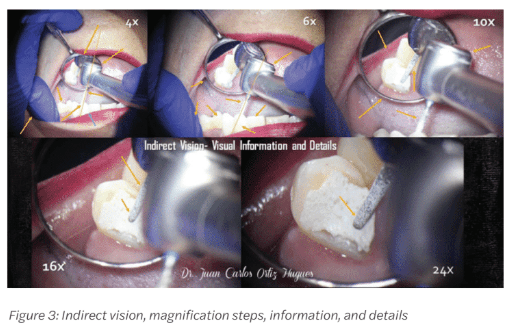
Magnification Depth of Field of View Setting (MDOFS) presents a significant challenge for new microscope users, particularly in the realm of stereoscopic microscopy. A solid understanding of magnification and optics is crucial for a smoother experience.10
Once the operator is optimally positioned at the 12 o’clock position, and the patient is comfortably situated, adjustments to the microscope for interpupillary distance and parfocality should be made. This process is typically performed only once if the same user consistently operates the microscope. The operator should start by targeting the tooth at lower magnifications to ensure a broader field of view before starting the procedure. After successfully identifying the tooth, they can transition to higher magnification and utilize the microfocal knob to achieve a sharp image. This initial focus at high magnification ensures that all lower levels remain in clear view.
A common mistake in endodontics is the reliance on high magnification throughout procedures, which can lead to a loss of references and perspective due to the restricted field of view. Instead, it is advisable to predominantly use lower magnification to maintain visibility of essential reference points such as the fingertips, file rubber stops, cusp tips, and the axial inclination of the handpiece or file in relation to the tooth, reserving higher magnification for more detailed tasks (Figure 3).
Mirror handling skills (micromovements)
Research highlights the crucial role of line of vision in muscle activity, posture, and joint fatigue, particularly in dentistry.11 Mastering mirror handling during procedures is essential for enhancing dentists’ physical and cognitive skills.12 Incorporating this training into dental school curricula is vital for developing the neuromotor capabilities necessary for effective mirror use, especially with microscopes.13
When the operator and microscope are stationary, only the mirror and patient’s head can be adjusted. Neglecting these adjustments can lead to unintentional shifts in the microscope’s position, causing disruptions and awkward postures that can result in discomfort or injuries.
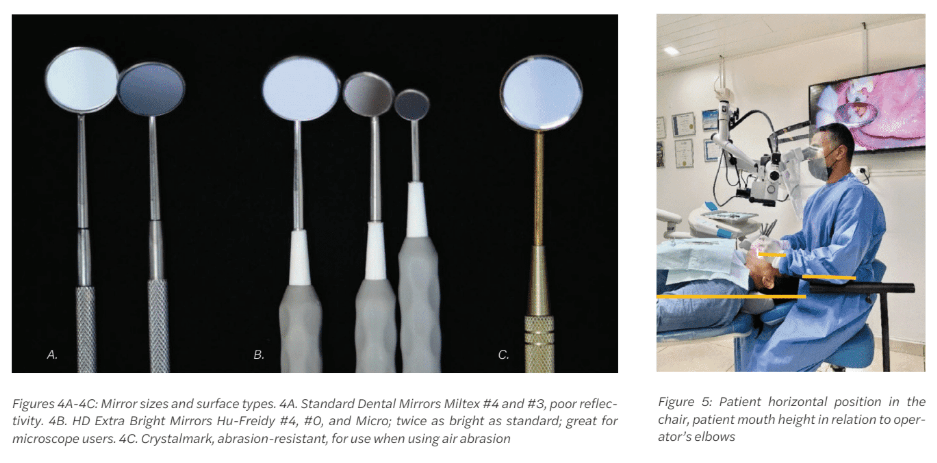
Utilizing mirror motions with intraoral fulcrum points is key for stable control, enabling precise movements and better visualization of difficult angles.14 Selecting a front surface mirror with rhodium or HD coatings offers sharper reflections, enhancing visual quality when paired with coaxial lighting and magnification15 (Figure 4).
Honing mirror skills allows dentists to achieve optimal focal sharpness, improving focus without needing to reposition the microscope or themselves. This proficiency not only elevates the quality of care provided but also promotes greater comfort for both dentist and patient, making it an invaluable skill in modern dentistry.
Patient positioning and head movements (macromovements)
By following a systematic approach to positioning, the operator can effectively control their posture once positioned at 12 o’clock behind the patient’s head, which impacts their interaction with the microscope.16
Patients should be placed horizontally in the dental chair, ensuring their mouth is directly below the microscope’s objective for ideal visibility. The patient’s head needs to be positioned at the end of the headrest, minimizing distance to maintain the operator’s posture and the microscope’s proper settings. Proper positioning also prevents forward-leaning postures that can strain the lower back and neck17 (Figure 5).
For optimal ergonomics, adjust the patient’s height so their mouth is at or slightly above the operator’s elbows. This helps align the microscope’s binoculars correctly, promoting a neutral head posture, wrist, and forearm alignment. Avoid inclining the backrest too much, as this can raise the mouth too high and lead to wrist extension and neck hyperextension. Conversely, if positioned too low, the binoculars may need to exceed safe angles, causing neck flexion.
Once positioned, use verbal instructions to guide the patient for clear views of occlusal, vestibular, palatal, and lingual surfaces by adjusting their chin or head position. These cues enhance visibility while minimizing interruptions, allowing for better focus and stamina for the operator18 (Figure 6).
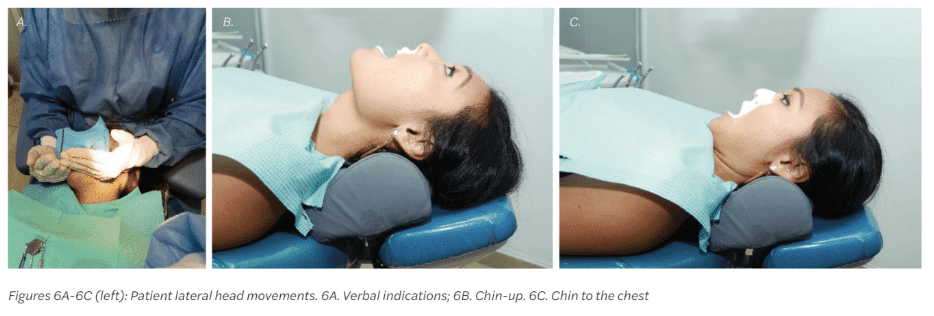
Patient Positioning Tips
- Position the patient horizontally.
- Keep the head at the end of the headrest.
- Adjust the height to align the mouth with the operator’s elbows.
- Use verbal cues to manage the patient’s head position for optimal visibility.
- Proper positioning protects the operator’s posture during procedures.
- The position of the patient’s mouth sets the microscope’s alignment with the operator’s head.
Four-handed dentistry enhances posture, positioning, movements, and overall workflow
To achieve 100% working time in microscope dentistry, both a trained assistant and effective organizational practices are essential. An assistant plays a crucial role in enhancing ergonomics, as dentistry is a team-oriented profession. They should receive the same level of training as the dentist, focusing on ergonomic principles to maintain both physical and mental stamina.19
Microscope dentistry requires the operator to maintain focus while working in the patient’s mouth, making an assistant vital. Without one, interruptions can occur when the operator needs to search for tools, which can negatively impact posture and lead to discomfort in key areas like the neck and back. This can also impair cognitive functions, leading to errors and wasted time.20,21
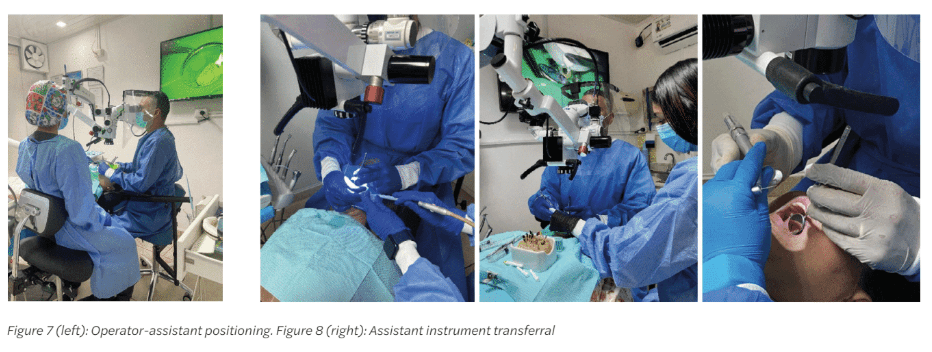
The assistant should be strategically positioned to optimize efficiency, keeping frequently used items within elbow reach while less frequently used supplies can be stored on a movable cart. This pre-organization facilitates swift instrument transfer, allowing the dentist to concentrate on their work while the assistant manages the surroundings22,23 (Figures 7 and 8).
Effective motion control by the assistant helps the dentist adhere to ergonomic principles,24 maximizing endurance and precision during endodontic lengthy procedures. Additionally, the assistant is responsible for maintaining visual clarity by managing any obstructions on the microscope’s mirror, typically using a triple syringe and high-vacuum suction.
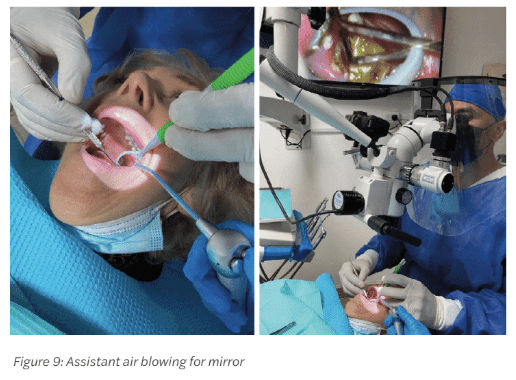
The organized arrangement of dental instruments, along with the expert motion control and transfer by the dental assistant, allows the dentist to adhere to Carr’sErgonomics Laws of Motion, particularly Classes I and II.6 This approach enables effortless instrument retrieval, enhancing endurance and precision during lengthy endodontic procedures while maintaining a smooth workflow. A crucial responsibility of the assistant in microscope dentistry is to keep the mirror free from water, dust, or fog. This meticulous task is vital, as it ensures the dentist can utilize indirect vision effectively, minimizing interruptions and allowing for greater focus and accuracy on the tooth (Figure 9).
To ensure the assistant’s well-being, ergonomic stools with features like height adjustment, negative seat inclination, and supportive backrests are recommended. A healthy assistant contributes significantly to overall productivity and efficiency in the practice.
Conclusion
Workflow is vital in all dental disciplines, particularly in endodontics, where professionals face challenges related to task complexity, static posture, decision-making, and the need for visual information. Endodontics has embraced technology more extensively than other specialties, yet the focus should extend beyond basic tasks like endodontic access or locating the MB2 canal. Endodontists should strive to use the microscope consistently throughout their practice.
This requires discipline and training within an ergonomic framework, evolving work practices to prioritize precision alongside the biomechanics of the human body and the cognitive advantages of the microscope. Proper use of this tool promotes neutral posture, improves motion efficiency, and enhances teamwork.
Think of the dental microscope as your safety seatbelt — an essential tool that upholds treatment quality and protects both the patient and practitioner from injury not occasionally, but always.
The endodontic microscope has had a revolutionary impact on the field. Read insights into its history and use, by Dr. Andrew R. Steidley here: https://endopracticeus.com/ce-articles/the-dental-operating-microscope-through-the-years-past-present-and-future/.
References
- Fidelis Mne ChiaA. Comprehensive Review of Ergonomics Principles and Applications on Optimizing Workplace Performance and Well-being. IRE Journals. Aug 2024;8(2). https://www.irejournals.com/paper-details/1706185. Accessed September 30, 2025.
- Gebhardt JS, Harth V, Groneberg DA, Mache S. Job Demands and Resources Perceived by Dentists in a Digital Dental Workplace and Perceived Effects on Job Satisfaction and Stress: A Qualitative Study. Clin Pract. 2025 May 12;15(5):92. doi: 10.3390/clinpract15050092.
- Kumar M, Pai KM, Vineetha R. Occupation-related musculoskeletal disorders among dental professionals. Med Pharm Rep. 2020 Oct;93(4):405-409. doi: 10.15386/mpr-1581. Epub 2020 Oct 25.
- Negucioiu M, Buduru S, Ghiz S, Kui A, Șoicu S, Buduru R, Sava S. Prevalence and Management of Burnout Among Dental Professionals Before, During, and After the COVID-19 Pandemic: A Systematic Review. Healthcare (Basel). 2024 Nov 26;12(23):2366. doi: 10.3390/healthcare12232366.
- Hugues JCO. Ergonomics Applied to Dental Practice. Quintessence Publishing; 2023.
- Carr GB, Murgel CA. The use of the operating microscope in endodontics. Dent Clin North Am. 2010 Apr;54(2):191-214. doi: 10.1016/j.cden.2010.01.002.
- American Association of Endodontics. Microscopes in Endodontics. https://www.aae.org/specialty/clinical-resources/microscopes-in-endodontics/. Accessed September 30, 2025.
- Bud M, Jitaru S, Lucaciu O, Korkut B, Dumitrascu-Timis L, Ionescu C, Cimpean S, Delean A. The advantages of the dental operative microscope in restorative dentistry. Med Pharm Rep. 2021 Jan;94(1):22-27. doi: 10.15386/mpr-1662. Epub 2021 Jan 29.
- Aurtenetxe S, García-Pacios J, Del Río D, López ME, Pineda-Pardo JA, Marcos A, Delgado Losada ML, López-Frutos JM, Maestú F. Interference Impacts Working Memory in Mild Cognitive Impairment. Front Neurosci. 2016 Oct 13;10:443. doi: 10.3389/fnins.2016.00443.
- Kumar RSM, Jain R, Vekaash V. Capturing precision: A guide to dental photomicrography. J Conserv Dent Endod. 2024 Oct;27(10):1085-1087. doi: 10.4103/JCDE.JCDE_653_24. Epub 2024 Oct 5.
- Katano K, Nakajima K, Saito M, Kawano Y, Takeda T, Fukuda K. Effects of Line of Vision on Posture, Muscle Activity and Sitting Balance During Tooth Preparation. Int Dent J. 2021 Oct;71(5):399-406. doi: 10.1016/j.identj.2020.12.025. Epub 2021 Feb 18. Erratum in: Int Dent J. 2022 Oct;72(5):731-733. doi: 10.1016/j.identj.2022.06.013.
- Garcia PPNS, Pugliesi PMS, Wajngarten D, Neves TDC, Pazos JM, Dovigo LN. Development and assessment of an indirect vision training programme for operatory dentistry: Effects on working posture. Eur J Dent Educ. 2022 Feb;26(1):36-44. doi: 10.1111/eje.12670. Epub 2021 Mar 18.
- Yıldırım YA, Süsgün Yıldırım Z, Ergun N. Evaluation of manual dexterity when using a mirror of dental students and academicians with increasing professional experience. Eur J Dent Educ. 2024 May;28(2):430-437. doi: 10.1111/eje.12965. Epub 2023 Nov 7.
- Stormon N. Shetty S. Instrumentation. The University of Queensland. https://uq.pressbooks.pub/dentistryenvironment/chapter/instrumentation. Accessed September 30, 2025.
- Bishayi D, Suvarna K, Singh S, Dutta A, Thomas MS. Technique Tips: A Reflection on Mouth Mirrors: Types, Usage and Modifications. Dental Update. October 2023;50(9):792-797.
- Valachi B. Practice Dentistry Pain-Free: Evidence-based Ergonomic Strategies to Prevent Pain and Extend Your Career. Posturedontics Press; June 15, 2008.
- Griegel-Morris P, Larson K, Mueller-Klaus K, Oatis CA. Incidence of common postural abnormalities in the cervical, shoulder, and thoracic regions and their association with pain in two age groups of healthy subjects. Phys Ther. 1992 Jun;72(6):425-431. doi: 10.1093/ptj/72.6.425.
- Pîrvu C, Pătraşcu I, Pîrvu D, Ionescu C. The dentist’s operating posture – ergonomic aspects. J Med Life. 2014 Jun 15;7(2):177-182. Epub 2014 Jun 25.
- Alnasser MY, Alsuliman S, AlYami DM. The impact of dental assistants in modern oral healthcare: A literature review. Advances in Oral and Maxillofacial Surgery. September 2025;19;100572. https://doi.org/10.1016/j.adoms.2025.100572.
- Chen Y, Fang W, Guo B, Bao H. Fatigue-Related Effects in the Process of Task Interruption on Working Memory. Front Hum Neurosci. 2021 Nov 17;15:703422. doi: 10.3389/fnhum.2021.703422.
- Abd-Elfattah HM, Abdelazeim FH, Elshennawy S. Physical and cognitive consequences of fatigue: A review. J Adv Res. 2015 May;6(3):351-358. doi: 10.1016/j.jare.2015.01.011. Epub 2015 Feb 24.
- Gupta A, Bhat M, Mohammed T, Bansal N, Gupta G. Ergonomics in dentistry. Int J Clin Pediatr Dent. 2014 Jan;7(1):30-34. doi: 10.5005/jp-journals-10005-1229. Epub 2014 Apr 26.
- Yang J, Abdel-Malek K. Human reach envelope and zone differentiation for ergonomic design. Human Factors and Ergonomics in Manufacturing & Service Industries. 2009;19 (1):15–34. Wiley Online Library. doi.org/10.1002/hfm.20135.
- FDI World Dental Federation. Ergonomics and posture guidelines for oral health professionals. https://www.fdiworlddental.org/sites/default/files/202104/FDI_HSDW_ergonomics_and_posture_guidelines_eng_2021.pdf. Accessed September 30, 2025.
Stay Relevant With Endodontic Practice US
Join our email list for CE courses and webinars, articles and more..