
Find out more about the important and overlapping roles of resin-based and bioceramic sealers in endodontic practice.
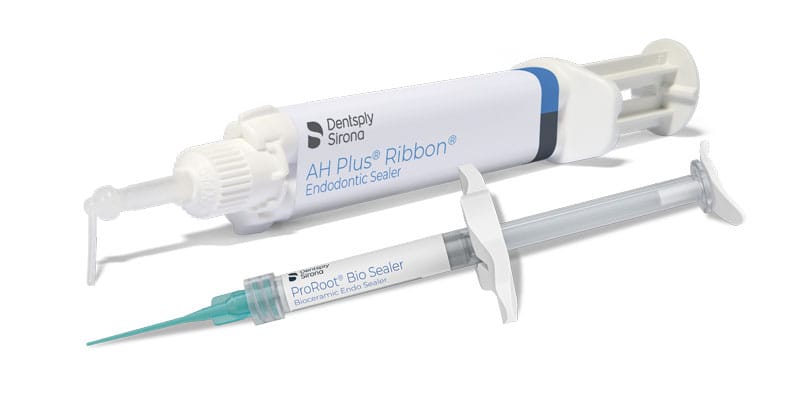
As a dentist, the choice between bioceramic sealers, such as ProRoot® Bio Sealer, and resin-based sealers, such as AH Plus® Ribbon®, can depend on the specific clinical situation. Both are suitable for everyday use, but each offers distinct properties that could be beneficial in different treatment scenarios.
Bioceramic sealers, as ProRoot Bio Sealer, offer bioactive properties that can be highly beneficial in specific clinical contexts. These materials release calcium ions, which facilitate the formation of hydroxyapatite and present a high pH through the release of hydroxide ions. Clinical studies suggest that bioceramic sealers may promote faster healing of periapical lesions, which is possibly due to these properties.1 Therefore, they could be beneficial when there is a periapical lesion. Additionally, they could also be favorable in cases of complex anatomy. Unlike resin-based sealers, bioceramics are hydrophilic and set in the presence of moisture, making them particularly valuable in cases where complete dryness of the canal is difficult to achieve.2 Their dimensional stability and hydrophilic nature make them well-suited for use with single cone technique, also referred to as sealer-based obturation. This method leverages the sealer’s properties to create a three-dimensional seal through hydraulic pressure, simplifying the obturation. In addition, this technique allows avoiding excessive vertical or lateral compaction forces and thereby the risk of vertical root fracture.3 Still, ProRoot Bio Sealer is also compatible with warm obturation techniques.
In contrast, resin-based sealers are commonly used in techniques in which the primary seal of the root canal is provided by the gutta percha. One of the main advantages of these sealers is their excellent sealing ability. Resin-based sealers, such as AH Plus® Ribbon®, demonstrate adhesion to both dentin and gutta percha.4,5 They also present low solubility, ensuring a long-term hermetic seal of the root canal system, preventing microorganisms and their by-products from leaking into the periapical region.6 This results in a tight seal that helps reduce the risk of leakage and microbial recontamination. Additionally, resin-based sealers offer a longer working time, making them particularly useful in complex or time-consuming procedures. Furthermore, AH Plus® Ribbon® presents outstanding radiopacity,9 allowing to clearly distinguish the sealer from surrounding anatomical structures to easily control the obturation radiographically. Resin-based sealers do not require moisture for setting which makes them less technique sensitive, and they can be used with all obturation techniques, including warm vertical compaction, carrier-based obturation, cold lateral condensation, and cold single cone. Regarding the latter technique, and contrary to what was thought for a long time for resin-based sealers, the newly reformulated AH Plus® Ribbon® exhibits slight expansion after setting, making it suitable for use with the cold single-cone technique.7
Due to their long-standing use in endodontics, there is substantial clinical evidence supporting the comparable success rates of resin-based and bioceramic sealers. In a recent systematic review and meta-analysis on this topic, the clinical success rate for AH Plus ranged from 86.2% to 100% (3-24 months of follow-up) versus 75% to 100% for bioceramic sealers.8
Dr. David Landwehr explains, “With the two sealers, I now have the best of both worlds. With the new and improved AH Plus Ribbon, I will continue to get all of the benefits I have appreciated from a resin-based sealer over my 25 years as a clinician, but now with increased consistency in the mix. The ProRoot Bio Sealer gives me greater versatility when I feel a bioceramic alternative provides a clinical benefit in challenging cases and very complicated anatomies filled with a single-cone obturation.”
In sum, both resin-based and bioceramic sealers have important and largely overlapping roles in endodontic practice and allow clinicians to achieve a successful treatment. Understanding their respective strengths allows clinicians to select the most appropriate material based on the clinical demands of each case.
Read more about the launch of Dentsply Sirona’s advanced endodontic sealers, Bioceramic ProRoot® Bio Sealer and AH Plus® Ribbon®, here: https://endopracticeus.com/industry-news/dentsply-sirona-launches-advanced-endodontic-sealers-bioceramic-proroot-bio-sealer-and-ah-plus-ribbon/.
- Khandelwal A, Janani K, Teja K, Jose J, Battineni G, Riccitiello F, Valletta A, Palanivelu A, Spagnuolo G. Periapical Healing following Root Canal Treatment Using Different Endodontic Sealers: A Systematic Review. Biomed Res Int. 2022 Jul 8;2022:3569281. doi: 10.1155/2022/3569281.
- Küçükkaya Eren S. Clinical applications of calcium silicate-based materials: a narrative review. Aust Dent J. 2023 Jun;68 Suppl 1:S96-S109. doi: 10.1111/adj.12986. Epub 2023 Oct 26.
- Al-Hiyasat AS, Sawallha AM, Taha NA. The effect of sealer type and obturation technique on the fracture resistance of endodontically treated roots. Clin Oral Investig. 2023 Dec;27(12):7359-7367. doi: 10.1007/s00784-023-05326-2. Epub 2023 Nov 3.
- Maharti ID, Larasputri I, Herdianto N, Margono A, Tasomara R, Rosseti R. A comparative analysis of adhesion abilities between AH Plus® Bioceramic, Ceraseal® and AH Plus® on root canal dentine surfaces. J Conserv Dent Endod. 2025 Sep;28(9):881-885. doi: 10.4103/JCDE.JCDE_406_25. Epub 2025 Sep 5.
- De-Deus G, Oliveira DS, Cavalcante DM, Simões-Carvalho M, Belladonna FG, Antunes LS, Souza EM, Silva EJNL, Versiani MA. Methodological proposal for evaluation of adhesion of root canal sealers to gutta-percha. Int Endod J. 2021 Sep;54(9):1653-1658. doi: 10.1111/iej.13549. Epub 2021 Jun 10.
- Silva EJ, Perez R, Valentim RM, Belladonna FG, De-Deus GA, Lima IC, Neves AA. Dissolution, dislocation and dimensional changes of endodontic sealers after a solubility challenge: a micro-CT approach. Int Endod J. 2017 Apr;50(4):407-414. doi: 10.1111/iej.12636. Epub 2016 Apr 17.
- Dimensional stability comparison testing was conducted according to the test method in ADA#57 R2012 5.8, with adapted acceptance criteria. Data on file.
- Zamparini F, Lenzi J, Duncan HF, Spinelli A, Gandolfi MG, Prati C. The efficacy of premixed bioceramic sealers versus standard sealers on root canal treatment outcome, extrusion rate and post-obturation pain: A systematic review and meta-analysis. Int Endod J. 2024 Aug;57(8):1021-1042. doi: 10.1111/iej.14069. Epub 2024 Apr 12.
- Radiopacity [mmAI/mm] comparison test result according to ISO 6876-2012. Data on file.
Stay Relevant With Endodontic Practice US
Join our email list for CE courses and webinars, articles and more..