
Drs. Amil Sharma, Gregori Kurtzman, Greeshma Gupta, and Sharmistha Sharma outline the impressive capabilities of machine learning (ML) and deep learning (DL) frameworks involved in artificial intelligence that can helps dentists make better decisions about patient care.
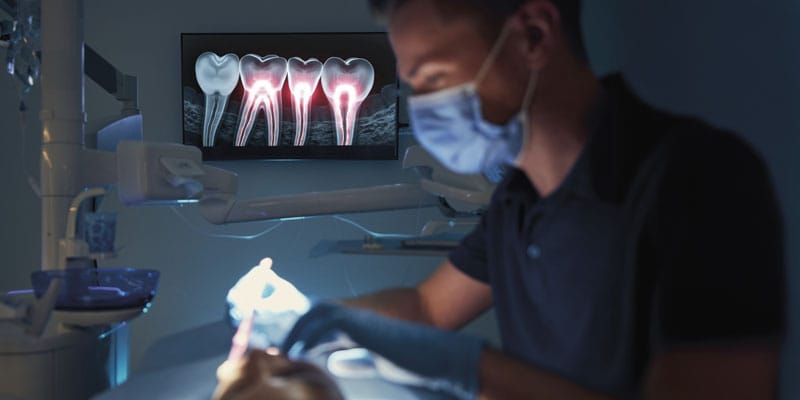
The transformative impact of artificial intelligence on endodontic practice
Drs. Amil Sharma, Gregori Kurtzman, Greeshma Gupta, and Sharmistha Sharma discuss AI’s growing role in endodontics
Introduction
Over the years, there have been significant technological developments in endodontics. Modern technologies and methods contributed to these advancements, the most remarkable recent achievement being the introduction of artificial intelligence (AI), which is generally considered to be the branch of software engineering that makes it possible for computer systems to do tasks that would require human intelligence. The capacity for this type of technology currently is bringing about innovations in endodontics.
Machine learning (ML) and deep learning (DL), both aspects of artificial intelligence (AI), are making a major impact on diagnosis,treatment planning, and accurate judgment. Tools that use AI are highly effective at data analysis, recognition of patterns, and decision-making. They are capable of decoding complicated data from a wide range of sources. For example, they are more accurate than the human eye at examining radiography images to find root fractures or minor periapical diseases. The development of more specific treatment plans also becomes possible by this advancement in technology, which increases the overall efficacy of clinical procedures and improves the accuracy of diagnosis.1-3 AI is expected to have a greater role in endodontics as it advances and expands over time, giving doctors valuable new methods to deliver improved patient care.
Fundamentals of AI in endodontics.
The impressive capabilities of machine learning (ML) and deep learning (DL) frameworks are largely behind the effective introduction ofAI into endodontic practice. Processing of medical data has changed significantly as a result of these advanced computational models that are developed to find complex patterns from huge databases without requiring specific programming. Artificial neural networks (ANNs),which have been created to mimic the human brain and have the skill of detecting complex links in data, are at the core of these systems. The incredible ability of convolutional neural networks, or CNNs, to process and analyze visual information made them a particularly efficient tool for endodontics. CNNs are trained on many thousands of dental radiographs and cone-beam computed tomography (CBCT) images to recognize important features such as the presence of fractures, root canal systems, and subtle changes in bone density. Having the capability to provide accurate, data-driven insights is changing diagnostics. Being highly effective in detecting periapical diseases, these networks are vital for evaluating outcomes from treatment, which helps dentists in making better decisions about patient care.1,4,5
Clinical applications.
AI has a wide range of clinical applications in endodontics, assisting dentists with a variety of tasks that enhance the results of treatment and accuracy in diagnosis. Convolutional Neural Networks (CNNs) area kind of artificial intelligence (AI) which have shown huge potential in the analysis of dental radiography images. The ability to identify small periapical lesions that the human eye would miss is significantly improved by this technology.6,7. Along with contributing to detecting diseases, AI helps figure out conditions that are not easy to notice, like vertical root fractures, which is crucial for making accurate treatment choices.8 Also, AI tools give vital support during clinical treatment procedures. They give an accurate method of determining working length, providing accurate measurements that are crucial for a successful root canal treatment.9 In addition, the technology is very helpful for identifying the complexity of root canal systems, which, if neglected, isone of the primary reasons why treatment fails.10,11 On a bigger scale, AI assists in interpreting retreatment results using clinical and radiographic images,thus helping in understanding the treatment outcomes.12 It may perform even more difficult procedures to improve procedural accuracy and predict outcomes; for example, machine learning simulation modules are being generated.13 In the emerging field of regenerative endodontics, artificial intelligence is also proving to be a useful tool to determine the pulp’s stem cells’ viability for successful regeneration procedures.14
Performance and validation
Many studies have shown that AI is accurate and reliable. In a number of diagnostic tasks, AI showed an impressive capacity to compete with or exceed experienced clinicians, especially when it comes to the complex interpretation of radiographs and images.3,7,15 The ability of AI to evaluate datasets and detect small anomalies that the human eye could miss is mainly responsible for this higher efficiency. However, it is important to understand that AI is an effective adjunct to clinical judgment rather than an alternative for clinical skill.
These technologies help as additional decision support tools, giving dentists a logical alternative opinion that can help confirm a diagnosis or point out apparent errors or conditions that appear confusing. The chances for diagnostic errors significantly decrease by combining the unique speed and precision of AI with the experience, ethical judgement, and critical thinking of an experienced physician. It ultimately ends in better and more reliable patient outcomes.16
Challenges and limitations
Currently, there are several challenges and limitations to the widespread clinical use of AI in endodontics. One of the primary difficulties is the basic need for massive and high-quality datasets, as a shortage of data for training and validation severely decreases the learning ability of AI models.2,4,16 Constant issues regarding data privacy, security breaches, and models are essential concerns that must be taken seriously when working with sensitive patients and can cause additional challenges.13,17
Besides the data-related barriers, due to the high costs and the requirement for doctors to learn new systems, using AI often requires the usage of special software and hardware, thus causing big obstacles to adoption.5,6 Similarly, a number of advanced AI models are defined as “black-box” models, meaning it is hard to understand how they make decisions.7,12 Since it disagrees with the need for experts to fully understand and justify their diagnostic and treatment decisions, and also since it may make it difficult to fulfill established clinical guidelines, this lack of transparency can be a major obstacle to its use.17 It is difficult to fill the gap and fully adopt new technologies into daily practice because of these problems, which eventually result in long-term gap between the technical world of AI research and the practical uses of clinical dentistry.13,18
Future perspectives
AI in endodontics has a bright future, bringing with it a new era of improved access to care, precision, and customization. The ability to develop highly personalized and calculated treatment plans which take into consideration each patient’s unique anatomy and clinical situation will be one of the most significant developments.1,11 The ability of artificial intelligence to analyze huge data sets and predict the most effective course of action will accelerate this change from one-size-fits-all to a patient-specific strategy.
AI also has the ability to significantly increase endodontic treatment accessibility. Better triage and early action will be provided to patients in remote or underserved regions due to the development of AI-driven online consultation platforms that will enable preliminary diagnosis and screening.15 This has been aided by the introduction of technologies like augmented reality (AR), which will enhance the effectiveness of treatment through providing dentists a visual overlay of a patient’s anatomy in real time during a procedure, significantly improving efficiency and decreasing chances of mistakes.6,13
AI will also serve as a constant resource for support in the clinical setting. Real-time support methods will act as a virtual “co-pilot” that guides the clinician during difficult treatments, providing immediate responses and advice.14 In addition, through analyzing patient data, these expert-level AI systems will be able to recognize diseases early on, often before they’ve become clinically apparent, which permits proactive treatment that can avoid more serious diseases.,10 At the end, more predictable, effective, and patient-centered endodontic care will be achieved from its focus on personalized treatment plans which are based on data unique to each patient.19
Conclusion
AI has tremendous ability to revolutionize endodontic diagnosis, treatment, and learning. In the near future, AI will play an important role in endodontic treatment, accuracy, efficiency, and diagnosis, even with the current limitations, due to ongoing advancements and globally ethical acceptance.2,3,6,17
At this time, the use of AI should be minimal, because it is essential to ensure that while we embrace newer technology, we don’t rely totally on AI, or compromise endodontists’ ability to do their own proper diagnosis and treatment planning.
Cybersecurity expert Gary Salman offers best practices for maintaining security in practices that use artificial intelligence software in his article, “Integrating AI in dental practices,” here: https://endopracticeus.com/integrating-ai-in-dental-practices/.
References
- Parinitha MS, Doddawad VG, Kalgeri SH, Gowda SS, Patil S. Impact of Artificial Intelligence in Endodontics: Precision, Predictions, and Prospects. J Med Signals Sens. 2024 Sep 2;14:25. doi: 10.4103/jmss.jmss_7_24.
- Dennis D, Suebnukarn S, Heo MS, Abidin T, Nurliza C, Yanti N, Farahanny W, Prasetia W, Batubara FY. Artificial intelligence application in endodontics: A narrative review. Imaging Sci Dent. 2024 Dec;54(4):305-312. doi: 10.5624/isd.20240321. Epub 2024 Aug 25.
- Sakly EH, Fornara R, Kaliaperumal K, Hawwaz ZM, Cavalcanti AL, Jabbar FA, Hussein L. Artificial Intelligence in Endodontics. G Ital Endod. 2025;39(1):33-40. doi.org/10.32067/GIE.2025.39.01.04.
- Bakhsh AA. A narrative review on the current uses of artificial intelligence in endodontics. Saudi Endod J. 2024;14(2):164-171. doi: 10.4103/sej.sej_199_23.
- Kumar PR, Ravindranath KV, Srilatha V, Alobaoid MA, Kulkarni MM, Mathew T, Tiwari HD. Analysis of Advances in Research Trends in Robotic and Digital Dentistry: An Original Research. J Pharm Bioallied Sci. 2022 Jul;14(Suppl 1):S185-S187. doi: 10.4103/jpbs.jpbs_59_22. Epub 2022 Jul 13.
- Lai G, Dunlap C, Gluskin A, Nehme WB, Azim AA. Artificial Intelligence in Endodontics. J Calif Dent Assoc. 2023;51(1). doi.org/10.1080/19424396.2023.2199933.
- Marwaha J. Artificial intelligence in conservative dentistry and endodontics: A game-changer. J Conserv Dent Endod. 2023 Sep-Oct;26(5):514-518. doi: 10.4103/JCDE.JCDE_7_23. Epub 2023 Sep 16.
- Sudeep P, Gehlot PM, Murali B, Mariswamy AB. Artificial intelligence in endodontics: A narrative review. J Int Oral Health. 2023;15(2):134-141. DOI:10.4103/jioh.jioh_257_22.
- Agrawal P, Nikhade P. Artificial Intelligence in Dentistry: Past, Present, and Future. Cureus. 2022 Jul 28;14(7):e27405. doi: 10.7759/cureus.27405.
- Goncharuk-Khomyn MY, Noenko I, Cavalcanti AL, Adiguzel O. Artificial intelligence in endodontics: Relevant trends and practical perspectives. Ukr Dent J. 2023;2(1):96-101. doi:10.56569/UDJ.2.1.2023.96-101.
- Ramezanzade S, Laurentiu T, Bakhshandah A, Ibragimov B, Kvist T, Bjørndal L. The efficiency of artificial intelligence methods for finding radiographic features in different endodontic treatments – a systematic review. Acta Odontol Scand. 2023 Aug;81(6):422-435. doi: 10.1080/00016357.2022.2158929. Epub 2022 Dec 22.
- Setzer FC, Li J, Khan AA. The Use of Artificial Intelligence in Endodontics. J Dent Res. 2024 Aug;103(9):853-862. doi: 10.1177/00220345241255593. Epub 2024 May 31.
- Ourang SA, Sohrabniya F, Mohammad-Rahimi H, Dianat O, Aminoshariae A, Nagendrababu V, Dummer PMH, Duncan HF, Nosrat A. Artificial intelligence in endodontics: Fundamental principles, workflow, and tasks. Int Endod J. 2024 Nov;57(11):1546-1565. doi: 10.1111/iej.14127. Epub 2024 Jul 26.
- Sanjana V, Krishna N V, Prasad SD, Chandrasekhar M, SunilKumar C, SunilKumar S. Artificial Intelligence in Endodontics. Int J Med Sci Curr Res. 2022; 5(1):1161-1165.
- Karobari MI, Adil AH, Basheer SN, Murugesan S, Savadamoorthi KS, Mustafa M, Abdulwahed A, Almokhatieb AA. Evaluation of the Diagnostic and Prognostic Accuracy of Artificial Intelligence in Endodontic Dentistry: A Comprehensive Review of Literature. Comput Math Methods Med. 2023 Jan 31;2023:7049360. doi: 10.1155/2023/7049360.
- Gunec HG. Artificial Intelligence Applications in Dentistry. (Diş Hekimliğinde Yapay Zekâ Uygulamaları). “Endodontide Yapay Zekâ Uygulamaları.” (“Where are the Artificial Intelligence Applications in Endodontics?”) Publisher: Türkiye Klinikleri. 2023: 16-25.
- Boreak N. Effectiveness of Artificial Intelligence Applications Designed for Endodontic Diagnosis, Decision-making, and Prediction of Prognosis: A Systematic Review. J Contemp Dent Pract. 2020 Aug 1;21(8):926-934.
- Khanagar SB, Alfadley A, Alfouzan K, Awawdeh M, Alaqla A, Jamleh A. Developments and Performance of Artificial Intelligence Models Designed for Application in Endodontics: A Systematic Review. Diagnostics (Basel). 2023 Jan 23;13(3):414. doi: 10.3390/diagnostics13030414.
- Saxena T, Gupta N, Narula N, Agrawal V, Gupta J, Abraham D. Artificial Intelligence in Endodontics. Int J Med Sci Dent Res. 2024;7(4):104-112.
Stay Relevant With Endodontic Practice US
Join our email list for CE courses and webinars, articles and more..