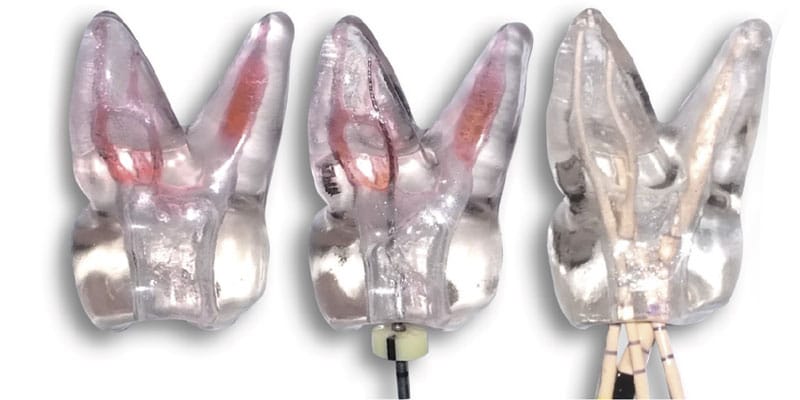
Dr. L. Stephen Buchanan created these tooth replicas for endodontics to provide anatomical authenticity and teach endodontic hand skills with more control and capability for repetition.
Dr. L. Stephen Buchanan discusses the benefits of 3D-printed tooth replicas and virtual hands-on training
Since the early 1900s, endodontic procedural training has been done primarily in extracted teeth, a fortunate protocol asdentists can start developing RCT skills before subjecting some poor patient to a first time experience with an as-of-yet unskilled dental student. Extracted teeth, while obviously the real deal in terms of anatomical authenticity, present several roadblocks to optimal hands-on training:
- They are gross, smelly, and usually infected
- The anatomy inside them is a random walk for both student and instructor
- This anatomy is hidden, so mental imaging skills develop at glacial speed
- There are no do-overs, so no chance of iterative skill development
- Extracted teeth are hard to come by—patients want to save, not extract teeth—so teeth collected from oral surgeons are either weird third molars or otherwise hacked up and decayed.
Replicas to the rescue
In 1995, I did RCT for the physicist who had just invented 3D printing, and when he described stereolithography, I thought my hair was going to light on fire because I had spent the last 5 years reconstructing micro CT scans of extracted teeth. The first thing I said was,“Do you think we could print teeth in 1:1 scale?”He said,“No, not yet; the printer’s finest resolution is 1 mm cubed, so curved canals would print like a staircase. No, it will probably be 20 years before that’s possible.”That was an amazingly accurate prediction because in 2017, after printing resolution got down to 0.016 mm, Iwas able to print the first extracted tooth replicas in both clear and opaque inks.
Since then, TrueTooth and TrueJaw replicas have been used worldwide, and of course, in my training lab in Santa Barbara. Here are a couple of things I’ve learned in the 8 years since their advent:
- Replicas can be chosen specifically for a given training exercise such as finding and treating MB2 canals in upper molars, managing impediments in canals, cruising through rare anatomy such as C-shaped molars, extraction and replacement by implants, apical micro-surgery, sinus lifts, etc.
- Replicas empower educators, for the first time, to teach hand skills by iteration. They are infinitely available for students to have one more try at a difficult technique, meaning that one can ledge and munge canals in 19 of the same replicas before “getting it” when operating the 20th, and by that process, own that skill. With extracted teeth, there are no do-overs, no mulligans; if you pooch the canal because it had a 90 degree apical bend, it’s going to be sometime before another canal like that presents itself in your extracted tooth jar. Not only that, but educators have no idea what anatomy is contained in their students’ teeth — it’s a random walk — so every exercise ends up being a one-on-one experience, with every student in a class dealing with different canal forms regardless of their skill level. With replicas, everybody in a training lab is working through the same exact challenges.
- Replicas are softer than human teeth so they are extremely easy to ledge, which at first blush seems to be “no bueno,” but in reality is perfect because after students have learned to avoid abusing impediments in a replica, they will never ledge a human root canal again for the rest of their careers.
- Clear and opaque replicas are ideal for teaching mental imaging skills. Mental imaging is the most important skill a dentist brings to a root canal party, and while some of us have a natural ability in that regard, most of us need help figuring out how to do that. Training in clear replicas provides a view of exactly what is happening; for instance, when a rotary file is cutting through a curved canal, The best experience is to first do it in a clear replica and see it, then do the same procedure without directly seeing it in an opaque replica. Lots of “aha’s” happen with this teaching method. The results have been amazing (see above image).
Control the anatomy, control procedural training
Shortly after the advent of TrueTooth replicas, it occurred to me that perhaps they could be used to train dentists to do new procedures in their own operatories, rather than having to travel to somebody’s training center. Thus Virtual Hands-On Training (VHOT) was born, but not fully realized until the COVID-19 pandemic shut down my training center for 2 years. The challenges to taking a remote site HOC:
- Cost of the course
- Airfare, hotel, and transportation
- Lost production — this is the greatest cost of off-site training
- Returning back to the office, inevitably finding out that needed tools are missing
- Having to train assistants in all the new methods from the HOC
With those hurdles in mind, as designed in my head, VHOT is essentially a hands-on training course in a box; that box has 18 replicas — one clear and 2 opaque replicas of each tooth type. It has all the instruments and tools needed for the procedure being taught, and inside the box is a Q-code that boots up the video demonstrations that lead students though the procedures being taught.
The first of four courses, “Cutting MIE Access Cavities,” is currently available; Part 2 on instrumentation is nearly finished, and the last two, Part 3-Irrigation and Obturation and Part 4-Post-endodontic Restorative, are in production. Here is what I’ve observed in working with dentists after they have taken the VHOT on access preparations:
- They spend more time on these exercises than we have time to teach them in the 2-day courses, usually spending 5-8 hours in their office instead of the 2 ½ hours we have available in the Santa Barbara facility. Furthermore, most users work through the exercises one at a time in 1-hour chunks so it’s not as overwhelming, and it is better retained than jamming through all of the material during the limited time we have to do it in the lab.
- Course participants most often worked through exercises when patients cancelled or no-showed — the ultimate scheduling efficiency for both practice as well as training.
- Dental assistants usually set up and assist during the exercises so they are getting trained at the same time as the doctor.
- Having all the right gear has made it more efficient and less frustrating when applying new skills to practice.
- Rather than just a less expensive HOC, the experience and speed running up the learning curve with VHOT is in many ways superior to in-person courses.
Conclusion
Virtual Hands-On Training empowers students to work at their own rate — they have total control over the day and time for each exercise, they retain more content when finished because it’s not crammed into a short window of time, and they can save thousands of dollars in the process.
Virtual Hands-On Training is not “as good” as an off-site course, it is better.
Besides creating tooth replicas for endodontics, Dr. L. Stephen Buchanan has become a top educator in his field. Read more about him here: https://endopracticeus.com/l-stephen-buchanan-dds/.
Stay Relevant With Endodontic Practice US
Join our email list for CE courses and webinars, articles and more..