Read about how the use of OdneClean helped an 89-year-old patient to achieve an impressive degree of healing in this case report.
Rapid radiographic healing of a large periapical lesion: a six‑month case review
Managing necrotic pulps with symptomatic apical periodontitis remains a frequent yet clinically demanding challenge in endodontic practice. Optimal outcomes rely heavily on effective disinfection and removal of biofilm and necrotic debris from the complex root canal anatomy. This case highlights the healing potential that can be achieved when standard instrumentation is combined with Odne®Clean, an advanced irrigation device that uses sterile water as its primary debridement medium delivered through an ultra-thin and flexible tip that is designed to optimize cleaning in the apical third. The result was an impressive reduction of a large periapical lesion within only 6 months, an encouraging outcome for both clinician and patient.
About OdneClean
Odne®Clean creates a hydro-dynamic cavitation cloud inside the root canal using sterile water as the main irrigation medium. With its 190 µm tip, the thinnest dental fluid-delivery tip on the market, the cavitation jet effectively cleans complex root canal geometries and apical thirds and increases the effect of the final standard needle disinfection rinse with NaOCl.1 Odne®Clean de-risks the procedure by significantly reducing the use of harsh disinfectants and eliminating the need for its activation.2,3 It also supports minimally invasive root canal treatments enabling endodontists and dentists to preserve as much tooth structure as possible. Visit https://odne.co/odne-clean/ to learn more.
Case presentation
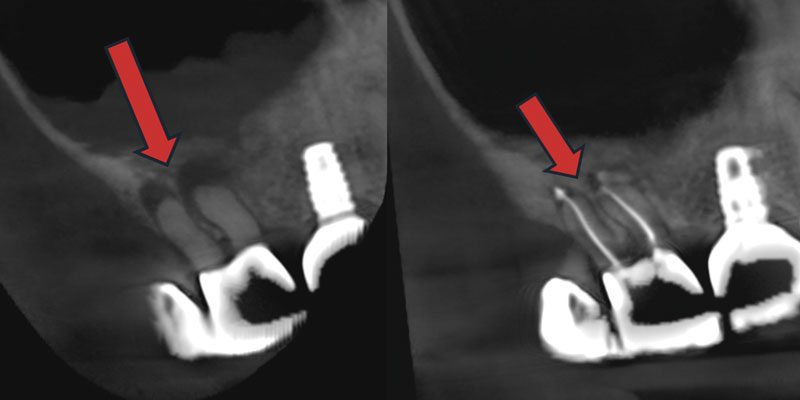
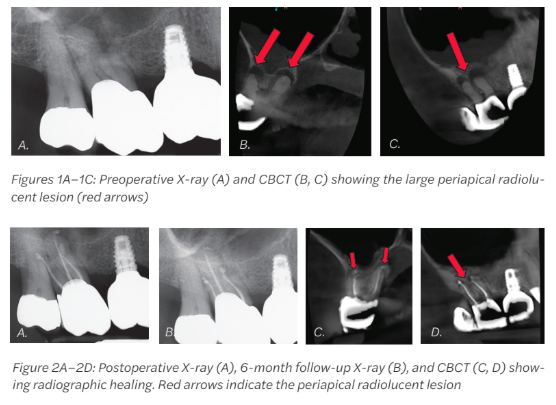
An 89-year-old male patient presented with unprovoked pain and clear pain on percussion. Clinical testing supported a diagnosis of pulp necrosis with symptomatic apical periodontitis, confirmed by radiographic evaluation. The preoperative radiograph showed a large, well-defined periapical radiolucency, consistent with a PAI score of 5, indicating severe apical periodontitis (Figures 1A-1C).
Treatment protocol
After establishing access and confirming working length, canal instrumentation was carried out to size 35/.04 in all three canals. Shaping was performed using standard solutions, 5% NaOCl and 17% EDTA, followed by OdneClean`s clinical protocol.
Given the necrotic status of the tooth and the large lesion, calcium hydroxide was placed as an interim dressing. At the subsequent visit, the canals were irrigated again with OdneClean activation to remove the CaOH and dried before obturation. Obturation was completed using bioceramic BC Sealer™. A postoperative X-ray can be seen in Figure 2.
Follow-up and healing
At the 6-month follow-up, the patient was asymptomatic, and percussion testing was normal. Radiographic evaluation revealed a clear reduction in the periapical radiolucency, with the PAI score improving from 5 to 3, indicating significant healing (Figures 2A-2D).
The visual reduction in lesion size was substantial, going from large to small. Periapical lesions of this magnitude often require extended healing periods. Large scale studies report that 85% of lesion cases heal within 48 months, and 42.5% show clear healing or signs of healing at 6 months.4 Another study observed that, additionally, healing is strongly influenced by the initial lesion size and patient age.5 They reported that patients with fully healed lesions had a mean age of 41.2 years, compared with 52.8 years in unhealed cases. Healing time increased by 4.9% per year of age and 0.3% per mm³ of lesion volume.5 Remarkably, only 8.9% of large lesions healed completely within 6 months.5 Considering this evidence, the degree of healing observed in this 89-year-old patient is impressive.
Conclusion
This case highlights the successful management of a large periapical lesion associated with pulp necrosis and symptomatic apical periodontitis. The combination of standard instrumentation, calcium hydroxide dressing, and mechanical debridement using OdneClean contributed to significant healing within 6 months. The outcome reflects how thoughtful irrigation strategies can elevate everyday endodontic procedures and produce predictable, patient-centered results.
Clinical case courtesy of Dr. Elena Kurtz, Exclusively Endodontics, and provided by Odne.
Read more about OdneClean and how it has set a new standard in root canal therapy here: https://endopracticeus.com/odneclean-introducing-a-new-standard-in-root-canal-therapy/.
- Unpublished data from an external pre-clinical study.
- Internal study showed that NaOCl can be reduced by 50% compared to PUI.
- Liu H, Wang X, Wang Z, Shen Y. Evaluation of bacterial biofilm, smear layer, and debris removal efficacy of a hydro-dynamic cavitation system with physiological saline using a new ex vivo model: a CLSM and SEM study. BMC Oral Health. 2025 Jan 18;25(1):95. doi: 10.1186/s12903-025-05463-y.
- Metzger Z, Kfir A. Healing of apical lesions: how do they heal, why does the healing take so long, and why do some lesions fail to heal? Disinfection of Root Canal Systems: The Treatment of Apical Periodontitis, 2014; 297-318.
- Mosquera-Barreiro C, Ruíz-Piñón M, Sans FA, Nagendrababu V, Vinothkumar TS, Martín-González J, Martín-Biedma B, Castelo-Baz P. Predictors of periapical bone healing associated with teeth having large periapical lesions following nonsurgical root canal treatment or retreatment: A cone beam computed tomography-based retrospective study. Int Endod J. 2024 Jan;57(1):23-36. doi: 10.1111/iej.13993. Epub 2023 Nov 17.
Stay Relevant With Endodontic Practice US
Join our email list for CE courses and webinars, articles and more..